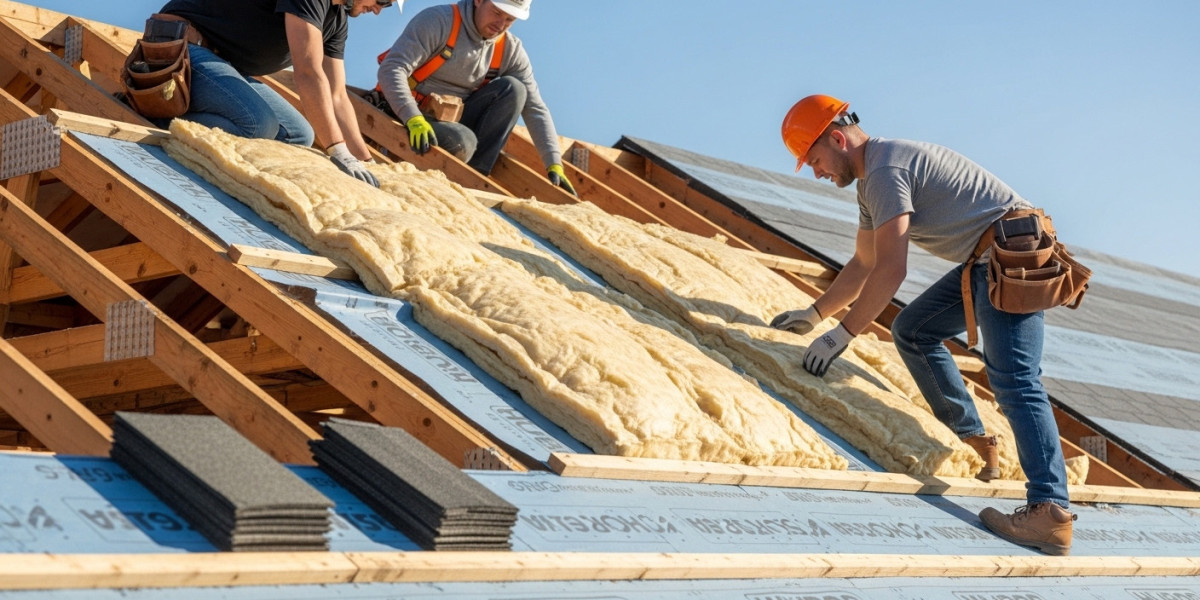

When housed in the US, roof insulation helps to minimize the heat loss in winter and the heat intake during summer. Thus, it helps homeowners keep their house comfortable throughout the year and, at the same time, reduces their energy bills. The proper insulation material and technique will depend upon your climatic region, type of roof, and whether your house is new or old.
Why Roof Insulation Should Be A Priority For Us Homes?
In the case of US homes, the major impact of roof systems on energy efficiency can be attributed to the fact that heat always rises. A significant amount of the cooled, conditioned air can be lost through the roof if it is not well-insulated, which causes the HVAC system to work overtime. This is very much experienced during extremely hot summers in Texas, Arizona, and Florida, and cold winters in the Midwest and Northeast.
In addition, roof insulation serves as a protective measure for the home from the outside elements. Different factors, such as temperature changes and moisture accumulation, can result in the growth of mold and wood decay and the formation of ice dams. Those who decide to insulate their homes adequately often enjoy benefits such as saving money in the long run, reduced maintenance, and better indoor air quality.
When it comes to building and remodeling, the plan for insulation is usually combined with the plan for the cost and the materials. The point of contact between the home energy advisor on one side and a team that provides the best material takeoff services on the other helps to avoid excessive use, waste, and overspending, and to be sure that the quantity and type of insulation are right for the project.
The Mechanism Of Roof Insulation
Heat Transfer Process
Generally, heat travels through three mechanisms: conduction, convection, and radiation. Roof insulation basically puts a limit on all of them. The heat transfer through conduction is lessened when the materials are dense, convection heat transfer is curtailed in a tightly sealed system, and heat radiation is reduced by the use of reflective layers. This applies most to hot US climates.
What R-Value Stands for in US Residences
The R-value stands for the measure of thermal resistance. The greater the R-value, the more effective the insulation will be. The US Department of Energy lists insulation R-values that are suitable for each climate zone and different types of roof assemblies. For instance, the house in Minnesota would require a significantly higher R-value than the one in Southern California.
Recommended Roof R-Values by Climate Zone
US Climate Zone | Typical States | Recommended R-Value |
Zone 1–2 (Hot) | FL, TX, AZ | R-30 to R-38 |
Zone 3–4 (Mixed) | CA, NC, TN | R-38 to R-49 |
Zone 5–7 (Cold) | NY, IL, MN | R-49 to R-60 |
Roof Insulation vs Attic Insulation
Many people who own houses confuse the insulation of the roof with the insulation of the attic floor. Attic insulation is placed on the ceiling of the living area, whereas roof insulation goes up the roofline. Roof insulation is typically a feature of houses with vaulted ceilings, finished attics, or air conditioning equipment located in the attic space in contemporary designs. By doing so, the attic becomes a conditioned space, which increases comfort and the efficiency of the system.
Roof Insulation Types Most Often Used in the US
Fiberglass Batt Insulation
Due to their affordability and availability, fiberglass batts are still one of the most popular choices. Usually, they are placed between rafters and perform well when the size and sealing are perfect. The problem, however, is that performance may be decreased due to gaps or if the material is compressed.
Blown-In (Loose-Fill) Insulation
Blown-in fiberglass or cellulose is very often the choice for retrofits. It has the ability to fill the cavities that are not regular better than batts, and is great for times when it is not easy to get to the spot. It works great in mixed and cold climates, but the air sealing has to be done properly beforehand.
Spray Foam Insulation
In the US, spray foam is gaining ground, especially when it comes to high-performance housing.
While open-cell foam blocks the air and also limits noise, closed-cell foam, on the other hand, gives you a higher R-value per inch and resists moisture. In coastal and hurricane-prone regions, closed-cell is often the choice.
Rigid Foam Board Insulation
One of the places where rigid foam boards are most often seen is on flat or low-slope roofs. They deliver a uniform R-value and can be used in both commercial and residential settings, especially in conjunction with reliable roofing estimating and roof replacement projects.
Radiant Barrier Insulation
Radiant barriers are reflective materials that are put up under the roof decking. They work best in hot climates where the biggest problem is the solar heat gain, as they can lower the temperature in the attic drastically.
Comparison of Common Roof Insulation Materials
Material | Best Use Case | Key Advantage |
Fiberglass Batts | Budget projects | Low cost |
Blown-In Insulation | Retrofits | Fills gaps |
Spray Foam | High-efficiency homes | Air sealing |
Rigid Foam Board | Flat roofs | High R-value |
Radiant Barrier | Hot climates | Reflects heat |
Roof Insulation Methods
Insulating Between Rafters (Cold Roof)
This approach puts insulation between the rafters and keeps air flowing over the top of the insulation. You will see it in the traditional type of pitched roof. It needs good and careful airflow management to prevent the moisture problem.
Adding Insulation On Top of the Roof Deck (Warm Roof)
A warm roof has a layer of rigid insulation on top of the roof deck. This way, thermal bridging is totally removed. This type of construction is favored by energy-conscious folks who generally go for flat roofs, especially in US city areas.
Flat Roof Insulation Systems
For flat roofs, the typical installation sequence is rigid boards with vapor barriers and waterproof membranes. Making sure the layers are in the right order is a must to avoid getting water and condensation.
Insulating Existing Homes vs New Construction
Insulation decisions at the time of construction go hand in hand with architectural and structural plans. If it is an old house, the choice of insulation materials will depend on things like how accessible it is, the status of the roof, and the configuration of the HVAC system. A lot of homeowners in the US opt to improve their insulation when they replace the roof or renovate the attic.
Vapor Barriers, Moisture Control, And Ventilation
Water in any form is one of the most damaging factors for roofs. Vapor barriers reduce the risk of condensation by limiting the movement of warm, moist air into the roof cavity. According to US building codes, in cold climates, good ventilation is a must to keep the mold and ice dams away.
Besides that, a roof that has been well ventilated will last longer, and the air inside will be better.
Cost Of Roof Insulation In The United States
The variation of costs depends on the combination of material, labor, and location. Spray foam usually goes at the top of the price wheel, whereas fiberglass batts are the least costly option.
Insulation Type | Average Cost (USD per sq ft) |
Fiberglass Batts | $1.00 – $2.00 |
Blown-In Insulation | $1.50 – $3.00 |
Spray Foam | $3.00 – $7.00 |
Rigid Foam Board | $2.50 – $5.00 |
In the long run, a higher initial price of upscale alternatives is often compensated for by larger energy savings.
Energy Savings, Rebates, And Tax Credits
Efficient roof insulation can help cut heating and cooling costs by 10 30%. Quite a few US homeowners are in a position to get federal tax credits or local utility rebates when they upgrade their insulation to meet energy efficiency standards. Such incentives help to make the use of higher-performance materials more affordable.
Common Roof Insulation Mistakes To Avoid
Failing to properly seal the house, choosing the wrong R-value, closing the vents, and completely neglecting moisture are the major problems that keep recurring. One ensures long-term performance while avoiding problems by hiring a trained and experienced professional.
Conclusion
Roof insulation is not just a construction feature but a real investment in comfort, durability, and energy efficiency of the housing stock in the US. Homeowners in the United States can enjoy a significant decrease in their utility bills along with healthier indoor environments for many years if they select suitable materials, conform to the climate-specific guidelines, and execute a well-thought-out plan.
FAQs
1. What Is The Best Roof Insulation For Hot Us Climates?
Radiant barriers combined with spray foam or blown-in insulation perform best in hot regions by reducing solar heat gain.
2. Can I Insulate My Roof Without Removing It?
Yes, many insulation upgrades can be done from inside the attic or ceiling without roof removal.
3. Is Spray Foam Worth The Higher Cost?
For many US homeowners, spray foam’s air sealing and energy savings justify the higher upfront investment.
4. How Long Does Roof Insulation Last?
Most insulation materials last 20–50 years when properly installed and protected from moisture.
5. Does Roof Insulation Increase Home Value?
Yes, energy-efficient upgrades like roof insulation can improve resale value and buyer appeal.