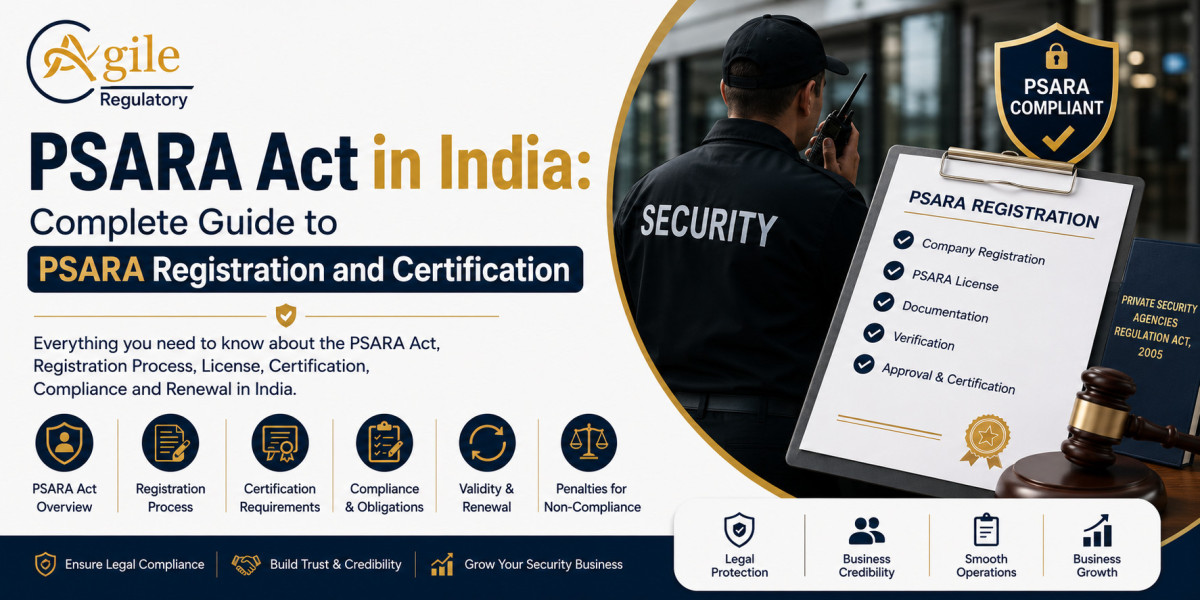

The private security industry plays a vital role in protecting businesses, residential communities, commercial establishments, educational institutions, and public infrastructure. To regulate private security agencies and ensure professional standards, the Government of India enacted the PSARA Act, which mandates licensing and compliance requirements for security service providers.
If you are planning to start a private security agency in India, understanding the PSARA registration process and obtaining a PSARA certificate is essential. This guide explains the requirements, eligibility, documents, registration procedure, and benefits of compliance under the PSARA Act.
What is the PSARA Act?
The PSARA Act refers to the Private Security Agencies (Regulation) Act, 2005. The Act was introduced to regulate the operations of private security agencies and establish standards for training, supervision, and management of security personnel.
Under the PSARA Act, private security agencies must obtain the necessary license before offering security services to clients.
The legislation aims to:
- Improve professionalism in the private security sector.
- Ensure proper training of security guards.
- Protect public interests.
- Maintain regulatory oversight of security agencies.
- Promote accountability within the industry.
What is a PSARA Certificate?
A PSARA certificate is commonly used to refer to the approval or license granted to a private security agency after successful registration under the PSARA Act.
The certificate serves as evidence that the agency has complied with applicable regulatory requirements and is authorized to provide private security services in the approved jurisdiction.
Without obtaining the required approval, a security agency cannot legally operate in India.
Why is PSARA Registration Important?
Completing PSARA registration provides several advantages:
- Legal authorization to operate a security agency.
- Enhanced credibility with clients.
- Compliance with regulatory requirements.
- Increased business opportunities.
- Better trust among corporate customers.
- Reduced risk of legal penalties.
- Recognition as a compliant security service provider.
For businesses entering the security services industry, registration is an essential requirement.
Who Needs PSARA Registration?
The following entities generally require PSARA registration:
- Private security agencies.
- Security guard service providers.
- Corporate security service companies.
- Event security service providers.
- Industrial security agencies.
- Residential security service providers.
Any organization offering security personnel services for commercial purposes must comply with the PSARA Act.
Eligibility Criteria for PSARA Registration
Applicants should meet the following general requirements:
Indian Entity Registration
The business should be legally established as:
- Proprietorship
- Partnership Firm
- LLP
- Private Limited Company
- Public Limited Company
Clean Background
Promoters and key personnel should satisfy applicable background verification requirements.
Training Arrangements
The agency should establish training arrangements for security personnel in accordance with applicable regulations.
Office Infrastructure
Applicants must maintain a registered office and necessary operational facilities.
Documents Required for PSARA Registration
The documentation requirements may vary by state, but commonly include:
Business Documents
- Certificate of Incorporation
- Partnership Deed
- LLP Agreement
Identity Documents
- PAN Card
- Aadhaar Card
- Passport-size Photographs
Office Documents
- Address Proof
- Rent Agreement or Ownership Documents
Operational Documents
- Employee Details
- Training Arrangements
- Affidavits and Declarations
Proper documentation helps ensure a smoother approval process.
Step-by-Step PSARA Registration Process
Step 1: Business Formation
Establish a legal business entity before applying for registration.
Step 2: Arrange Security Training
Enter into an arrangement with an approved training institute or establish an eligible training mechanism.
Step 3: Prepare Documentation
Collect all required documents and declarations.
Step 4: Submit Application
File the application with the designated licensing authority.
Step 5: Verification Process
Authorities review the submitted documents and conduct necessary verifications.
Step 6: Inspection and Compliance Review
In certain cases, inspections or additional reviews may be conducted.
Step 7: Approval and Issuance of PSARA Certificate
Upon successful verification, the authority grants approval and issues the PSARA certificate.
Key Compliance Requirements Under the PSARA Act
After obtaining registration, agencies must continue complying with regulatory obligations.
Employee Verification
Security personnel should undergo appropriate verification procedures.
Training Requirements
Guards must receive prescribed training before deployment.
Record Maintenance
Agencies should maintain proper records of employees and operations.
Renewal Compliance
Licenses must be renewed within the prescribed timelines.
Failure to comply with applicable requirements may result in penalties or regulatory action.
Benefits of a PSARA Certificate
Legal Business Operations
The certificate allows agencies to operate legally.
Improved Client Confidence
Corporate and institutional clients often prefer licensed agencies.
Competitive Advantage
Registration helps distinguish compliant businesses from unregistered operators.
Business Expansion Opportunities
Many tenders and contracts require proof of PSARA compliance.
Enhanced Reputation
The certificate demonstrates professionalism and commitment to regulatory standards.
Common Mistakes to Avoid
Applicants should avoid:
- Incomplete documentation.
- Incorrect application details.
- Failure to establish training arrangements.
- Delayed responses to authority queries.
- Non-compliance with employee verification requirements.
Proper planning can help prevent approval delays.
Why Professional Assistance Can Help
Many businesses seek professional support for PSARA registration because the process involves multiple compliance requirements.
Consultants can assist with:
- Eligibility assessment.
- Documentation preparation.
- Application filing.
- Regulatory compliance support.
- Follow-up with authorities.
Professional guidance often improves efficiency and reduces errors.
Conclusion
The PSARA Act establishes the legal framework for regulating private security agencies in India. Obtaining a PSARA certificate through proper PSARA registration is essential for businesses seeking to provide security services legally and professionally. By understanding the registration requirements, preparing accurate documentation, and maintaining ongoing compliance, security agencies can build credibility, attract clients, and operate successfully within the regulatory framework.
Frequently Asked Questions (FAQs)
1. What is the PSARA Act?
The PSARA Act is the Private Security Agencies (Regulation) Act, 2005, which regulates private security agencies operating in India.
2. What is a PSARA certificate?
A PSARA certificate refers to the approval or license issued to a private security agency after successful registration.
3. Is PSARA registration mandatory?
Yes, private security agencies generally require registration before providing security services.
4. Who can apply for PSARA registration?
Proprietorships, partnerships, LLPs, companies, and other eligible business entities involved in security services can apply.
5. What documents are required for PSARA registration?
Common documents include business registration records, identity proofs, office documents, and compliance-related declarations.
6. How long does the PSARA registration process take?
The timeline depends on document verification, regulatory review, and state-specific procedures.
7. What are the benefits of obtaining a PSARA certificate?
Benefits include legal compliance, improved credibility, business growth opportunities, and access to corporate contracts.
8. Can a security agency operate without PSARA registration?
Operating without the required registration may result in regulatory action and legal consequences under the PSARA Act.