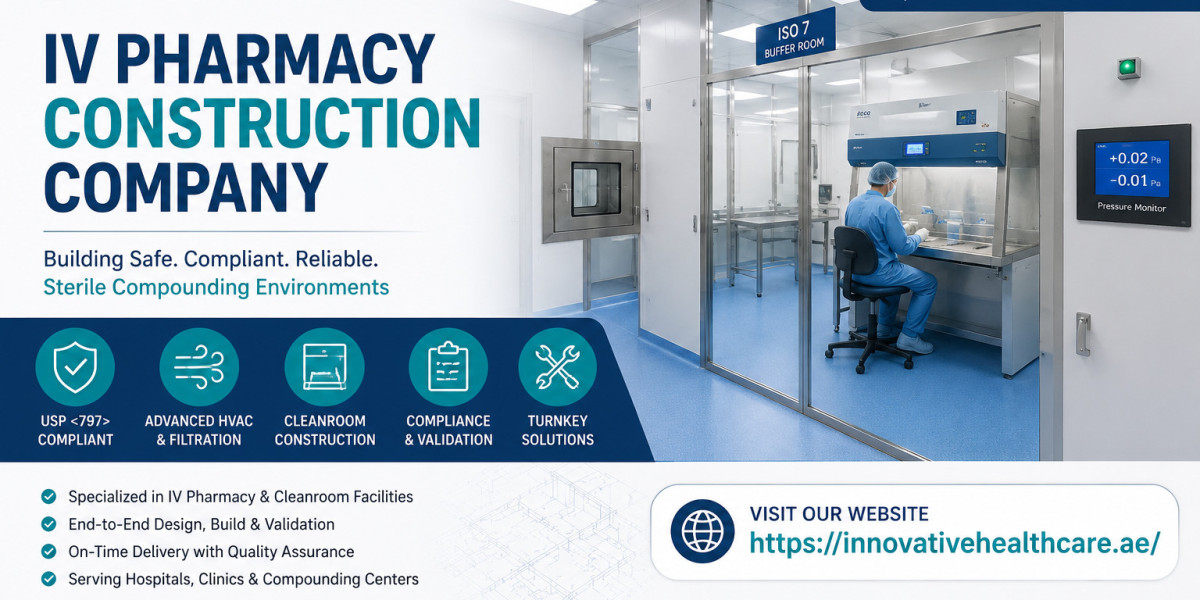

Building a sterile compounding pharmacy is not the same as building a normal healthcare room. That distinction becomes painfully clear when facilities start failing inspections, struggling with contamination risks, or facing workflow problems after construction is already complete.
After speaking with healthcare architects, sterile compounding pharmacists, and cleanroom engineers over the years, one thing consistently stands out — many healthcare groups underestimate how specialized an IV Pharmacy Construction Company really needs to be.
A standard contractor may understand walls, ceilings, and HVAC systems. Sterile pharmacy construction demands much more than that.
What an IV Pharmacy Construction Company Actually Does
An experienced IV Pharmacy Construction Company focuses on designing and building controlled environments where sterile medications can be prepared safely.
That includes:
USP <797> compliant cleanrooms
Hazardous drug compounding areas
Negative and positive pressure rooms
HEPA filtration systems
Laminar airflow integration
Pass-through chambers
Epoxy flooring systems
The work is extremely technical because patient safety depends heavily on environmental control.
Sterile Compounding Leaves Little Room for Error
One hospital facility manager explained how a minor airflow imbalance caused repeated compliance failures during testing.
The issue looked small on paper. In reality, it delayed operations for weeks and forced expensive reconstruction work.
That situation happens more often than people realize when inexperienced contractors attempt sterile pharmacy projects.
Why HVAC Design Is the Backbone of Sterile Pharmacy Construction
Most people assume cleanrooms are mainly about clean surfaces. Experienced engineers usually disagree.
Airflow is the real foundation.
A qualified IV Pharmacy Construction Company spends significant time planning:
Air changes per hour
Pressure differentials
HEPA filter placement
Temperature consistency
Humidity control
Contamination pathways
If airflow design is weak, even the best-looking pharmacy can fail certification.
Pressure Relationships Must Be Precise
In hazardous drug compounding spaces, pressure balance directly affects staff safety.
For example:
Hazardous rooms often require negative pressure
Sterile preparation spaces may require positive pressure
Buffer rooms and ante rooms must interact correctly
A slight imbalance can create contamination risks or regulatory violations.
Experienced cleanroom contractors test these relationships repeatedly before project handover.
Common Problems Healthcare Facilities Face During Construction
Many hospitals begin pharmacy renovations without fully understanding operational disruptions.
That creates serious issues later.
An experienced IV Pharmacy Construction Company usually plans construction phases carefully to reduce interruptions to medication preparation services.
Poor Workflow Design
One of the biggest mistakes involves inefficient room layouts.
If pharmacists constantly cross paths during compounding activities:
Productivity drops
Contamination risks increase
Compliance becomes harder
Smart workflow planning matters just as much as engineering systems.
Using Incorrect Materials
Not every healthcare material belongs inside a sterile cleanroom.
Experienced builders avoid surfaces that:
Trap particles
Crack under chemical exposure
Support microbial growth
Deteriorate during repeated sanitization
Materials inside sterile environments must survive aggressive cleaning procedures for years.
USP Compliance Has Changed Construction Expectations
Regulatory expectations around sterile compounding have become far stricter in recent years.
That shift forced many healthcare providers to upgrade outdated pharmacies.
An experienced IV Pharmacy Construction Company now works closely with:
Compliance consultants
Infection control teams
Pharmacists
Mechanical engineers
Certification agencies
Projects require coordination between multiple technical disciplines.
Documentation Is No Longer Optional
Healthcare operators now expect detailed records covering:
Air balancing
Pressure testing
HEPA validation
Room certification
Environmental monitoring readiness
Without proper documentation, passing inspections becomes far more difficult.
Real-World Construction Challenges Inside Active Hospitals
Building inside operational healthcare facilities creates problems that office contractors rarely encounter.
Noise restrictions, infection control procedures, and patient safety requirements affect every construction phase.
One project superintendent explained how workers had to coordinate material deliveries during limited overnight windows because nearby surgical areas remained active during the day.
That level of coordination separates specialized healthcare contractors from general builders.
How Experienced IV Pharmacy Construction Companies Reduce Risk
A knowledgeable IV Pharmacy Construction Company usually prevents problems long before construction begins.
That proactive approach often includes:
Pre-construction airflow modeling
Mockup reviews
Infection control planning
Workflow simulation
Utility coordination
Compliance verification
These steps reduce costly redesigns later.
Early Coordination Saves Significant Money
Several healthcare groups attempt to accelerate projects by reducing planning stages.
Ironically, rushed planning usually creates:
Failed inspections
Rework costs
Schedule delays
Equipment conflicts
Mechanical redesigns
Experienced cleanroom professionals rarely skip coordination meetings because small oversights become expensive quickly.
Technology Is Changing Sterile Pharmacy Design
Modern pharmacy facilities now integrate advanced monitoring systems that were uncommon a decade ago.
Many newer projects include:
Continuous pressure monitoring
Digital environmental tracking
Remote alarm systems
Automated airflow verification
Smart HVAC controls
An advanced IV Pharmacy Construction Company must understand how construction and technology infrastructure interact together.
That technical integration has become a major expectation among larger hospitals and compounding centers.
Choosing the Right Construction Partner
Not every contractor has healthcare cleanroom experience, even if they claim otherwise.
Healthcare operators should carefully review:
Previous sterile pharmacy projects
USP compliance experience
Cleanroom certifications
Mechanical coordination capability
Healthcare renovation experience
Asking detailed technical questions during contractor interviews usually reveals expertise gaps quickly.
Past Healthcare Experience Matters
One pharmacist shared how a previous contractor underestimated certification requirements entirely.
The facility looked visually impressive but failed operational testing multiple times because airflow performance was inconsistent.
Appearance means very little inside sterile environments if engineering systems fail under inspection.
Why Long-Term Performance Matters More Than Fast Construction
Fast project completion sounds attractive, especially for busy hospitals. Still, long-term reliability matters far more.
A properly designed pharmacy should maintain:
Stable environmental control
Easy sanitation procedures
Efficient staff movement
Reliable pressure relationships
Regulatory readiness
An experienced IV Pharmacy Construction Company focuses on operational durability rather than short-term construction speed alone.
That difference often determines whether a facility performs smoothly for years or struggles with ongoing compliance problems after opening.